-

Fire Stopping Surveys & Compartmentation Inspections
-
30+ YEARS
Exceptional industry standards
-
Nationwide
Responsive teams UK-wide
-
Fully certified
LPCB, Firas, BM Trada & ISO
Supporting our customers with Fire Stopping Surveys.
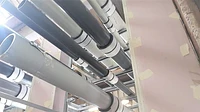
The Critical Role of Fire Compartmentation (firestopping)
Effectively 'stopping' a fire from spreading throughout your building, fire compartmentation is the most effective means of limiting fire damage before the fire brigade arrives.
By dividing building premises into “fire compartments”, fire is contained by forming a barrier against smoke, heat and toxic gases. This effectively holds the fire in the area of origin, providing protection for the building and its occupants.
Due to the vital role compartmentation should play in your overall fire strategy, it's fundamental that both the fire resisting partitions and fire doors should be
properly installed by expert teams who fully understand the importance of correct product installation for maximum fire safety.
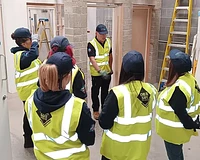
Fire Compartmentation (Fire Stopping) Survey Requirements
Article 17 of the Regulatory Reform (Fire Safety) Order 2005, in respect of the requirement for maintenance of fire safety provisions, states that it is advisable to set up a regular planned preventative maintenance programme for completed works.
In relation to compartmentation, the following guidance could be adopted in accordance with BS 9999: 2017: It is essential for the safety of the occupants of a building that fire safety equipment (including passive fire protection provisions) is inspected frequently. Although much of the inspection can be undertaken by suitably trained personnel, a formal agreement should be made with the installer or the installer’s representative to provide the regular inspection and testing described in the relevant British Standards for individual fire safety installations.
To satisfy this need Checkmate Fire offers a range of surveys and reports tailored to the client’s unique circumstance and priorities.
The best way to answer “Why firestopping?’ is by looking at the statistics.
- 75% of all fire deaths are caused by smoke inhalation
- Over half of fire-related deaths occurred in rooms where the fire did not originate
- Smoke can fill a 20 by 20 by 20-foot room through a pencil sized hole in less than 4 minutes
Firestopping and compartmentation came into its own in the late 1970s to help reduce the catastrophic loss of life and property caused by smoke and other airborne pathogens.
It is especially critical in buildings where the mobility of tenants is restricted, including hospitals, assisted living and nursing homes, along with high-rise buildings and prisons.
What to expect from a fire stopping compartmentation survey?
Our teams will visually inspect all areas of the identified compartment lines within your building to assess their likely performance in the event of a fire. Defects in compartmentation lines can take numerous forms and require expert indentification.
Common defects include: simple penetrations, such as pipework entering or exiting a compartment with gaps, or inappropriate firestopping, allowing smoke or fire to potentially pass from one compartment to another. Other defects include: cabling, voids, ducts or linear gaps where compartment lines do not fully encapsulate the compartment. These defects are either latent, from the original build, or imposed from subsequent works (such as M&E events). Both are reiterating the need for regular inspection.
What type of Compartmentation Survey do I require?
There are a number of differing compartmentation surveys available.
Dependent upon the type and use of your building, your fire strategy, and potentially the recommendations of an existing fire risk assessment, you may choose different levels of compartmentation survey. All inspections can cover common areas and dwellings dependent upon scope.
Checkmate Fire offer four distinct fire stopping survey types
Indicative
Checkmate Fire will undertake all elements of the "standard" compartmentation survey, but only to selected floors or areas of a building. This will give you the same detail of electronic reporting within your chosen areas, from which our specialists will extrapolate results to enable indicative results to be presented for review.
Standard
Our standard survey is classed as "invasive". This means we will review all areas of the building, along with inspecting some harder to reach areas, such as roof voids, above suspended ceilings, and through inspection hatches in solid ceilings.
Enhanced
This option provides all the benefits of the "standard" survey, but includes additional indicative destructive works, including a percentage of identified areas for further investigation. In most cases, this will include 10% of soil vent pipes and 5% of behind architraves. Our teams will make good on all works, with follow-up attention by your chosen decorator.
Destructive
All elements of the "non-intrusive" survey, together with a pre-defined scope of intrusive works that are defined as a greater requirement than the enhanced survey option. The Fire Compartmentation Inspection Report Electronically recording all deficiencies. along with photographic evidence, the report will highlight the following:
- A unique identifying number for each defect
- Location
- Room type
- Required fire rating
- Penetrating service type
- Seal type required
- Date and surveyor details
The Fire Compartmentation Inspection Report
Electronically recording all deficiencies, along with photographic evidence, the report will highlight the following:
- A unique identifying number for each defect
- Location
- Room type
- Required fire rating
- Penetrating service type
- Seal type required
- Date and surveyor details
Collaborate with Checkmate Fire
If you would like more information on how our team of experienced fire safety experts can help support you throughout these processes, please contact us via: enquiries@checkmatefire.com or 0330 124 7650 or complete the form below.
Our Accreditations